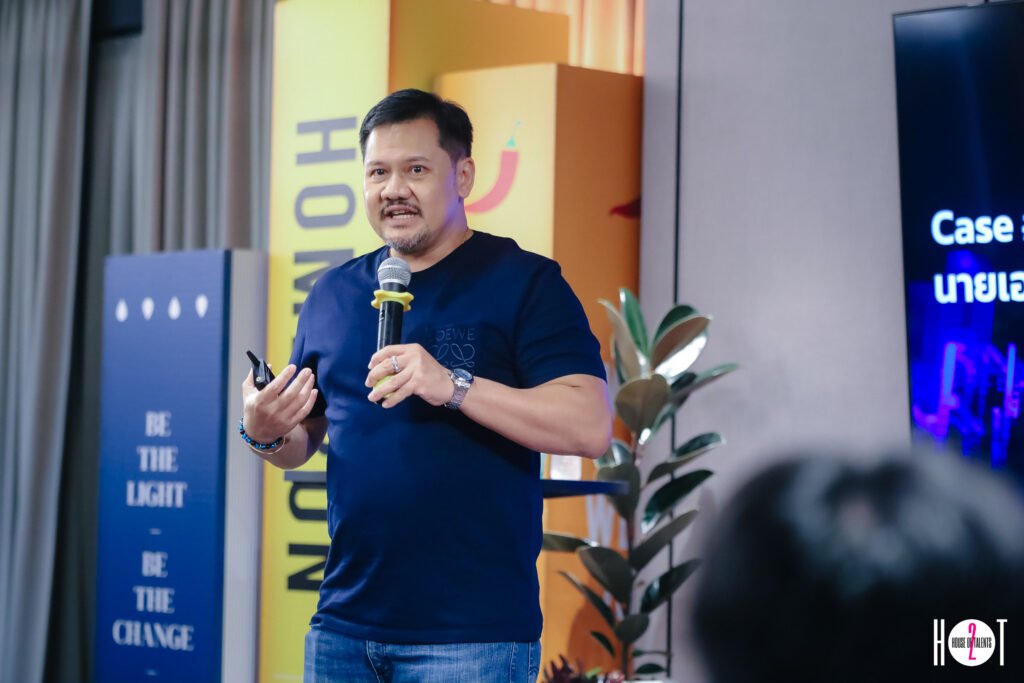
Profit Decoding: From Numbers to a Billion-Baht Business Plan #P'Benz

From goals → plans → action
1. Before thinking about how to grow, answer "where are we going?"
P'Benz started from the point that everyone runs a business with different goals. Some want to reach 1 billion baht, some want to reach 10 billion, so the way they run the business is different too.
There are 3 key questions to answer first:
- Why are we doing this business?
- Where do we want to get to?
- How fast do we want to get there?
For example, if the business is 100 million today and you want to reach 1,000 million gradually, growing 10–20% a year may be fine.
But if you want to go from 100 → 1,000 million within a few years, the old way won't work. You may need funding, acquisitions, partners or other ways to grow faster.
So same goal, different timeframe = different Strategy.
P'Benz added another angle: are we
Playing to Win — playing to win and grow, or
or
Playing Not to Lose — playing to protect what we have?
If you're already number 1 in the market, sometimes the job is to defend your position. But if you're still small and want to grow several times over, you can't play defensively.
2. Strategy has to look both "outside" and "inside"
P'Benz talked about looking at a business from 2 sides.
Outside-in — what's happening out there?
Look at things like
- Industry
- Competitor
- Market Trend
- Customer Trend
- Health / Convenience
- Customer Experience
And P'Benz stressed that
a good idea doesn't have to be one you invent entirely from scratch.
Many businesses see what has already worked overseas, adapt it to their own market, and do it faster or in a way that fits the local market better.
Inside-out — so what do we have?
Come back and look at
- what our strengths are,
- what Resources we have,
- what the Brand has going for it,
- and what abilities or Assets we have that others don't.
When you put Outside-in + Inside-out together, that's when it becomes an Opportunity and a Strategy that fits you.
3. A good plan shouldn't be full of "important" things
After analysing everything, P'Benz said you finally need to find
"which 3–5 things, if they succeed, will change the business over the next 1–3 years".
Examples of growth pillars he mentioned:
- Geography — expanding into new countries/areas
- Category — adding new types of products/businesses
- Strengthen Existing Business — making the existing business stronger, e.g. raising Margins, cutting Costs or gaining Market Share
So it's not finishing the analysis with 30 Actions — it's finding the "game changers".
4. A good business shouldn't stand on "one leg"
P'Benz gave the example that at one point Singha's business relied very heavily on Leo — most of the company's revenue came from one main Product.
The problem is that if that main leg ever runs into trouble, the whole company is at risk.
So the principle is:
use money from the "big brother" to build the "little siblings".
A strong business should gradually build a second and third leg.
The Cash Cow is the business where the market may no longer be growing much, but you have high market share. You try to make profit and generate Cash from it, then use that money to build new businesses with future growth potential.
5. When looking at a business, don't just look at "sales"
P'Benz talked about the financial numbers worth watching, especially 3 main ones.
① Revenue
Don't just look at "how much did we sell this year?"
Also look at whether
sales are growing / flat / falling.
Because the same number with a different Trend means something completely different.
② Gross Margin
See how much Margin is left after the cost of goods.
This shows the cost structure and how well the business can make profit.
③ Net Profit
How much real profit is left at the end?
And don't only look at your own numbers — Benchmark them against competitors or similar businesses to see where you're doing better or worse than others.
P'Benz compared MK and Suki Teenoi to show that just putting revenue, Margin and profit side by side already reveals how the two companies' Business Models differ.
6. "Profit" doesn't mean a company will survive — Cash matters a lot
One point P'Benz stressed heavily was Cash Flow
Some businesses
"are profitable, but close down because they run out of cash".
So when a company is in trouble, don't think only
"How do we get back to profit?"
The first thing to do is
"How do we stop the bleeding first?"
— in other words, stop the Cash Outflow.
7. Case: a loss-making restaurant business — the first move wasn't boosting sales
P'Benz shared the case of a restaurant business he was sent to help fix after COVID, when it was losing money.
The first thing P'Benz looked at was Cash Flow
because if you do nothing, the money runs out before you have time to revive the business.
What they did included:
- closing branches with no future
- postponing Renovations that weren't yet necessary
- renovating only what was truly necessary, like kitchens or restrooms
- cutting/optimising Marketing Spending
- cutting unnecessary expenses
The principle is:
Before you make a business grow, you have to make sure it "doesn't die".
Once Cash Flow and results turned positive again, they came back to think about how to keep growing.
8. You don't have to build everything yourself — use Partnerships
Another idea P'Benz uses often is that
if you don't have something, it doesn't mean you have to build it from zero.
You can bring in someone who already has it.
Example: ready-to-drink coffee
At first they wanted to make a Premium ready-to-drink coffee.
They could make the product themselves — the problem was the Brand
So instead of spending time building a new coffee brand, they approached a brand people already knew, Café Amazon to Partner with.
The result: an instantly strong Brand, without the burden of building Awareness/Marketing from scratch.
9. A good Partnership needs "something to exchange"
In the Q&A, P'Benz explained more about Partnerships:
a Partnership is like a marriage.
It's not
"What do we want from them?"
and nothing else,
but
but "What do we have that they want too?"
For example, a foreign company wanting to enter Thailand may have the Product / Technology / Brand, but not understand
- the Thai market,
- Regulation
- Network
- Local execution
If you have these, that's the Value you can exchange with them.
So before approaching a Partner, you need to be able to answer
what we give them, and what they give us.
Another important thing is compatibility — ways of thinking, ways of working and the Speed of doing business. If the two sides work at different rhythms, the Partnership can run into trouble.
10. A Japanese case: competitors don't have to fight to the death
P'Benz gave the example of the Japanese snack business Kameda
Both sides had been competing and losing money.
Eventually they talked:
"If competing is hurting us both, why not combine?"
Talks with the Japanese side took about 2 years, but once combined they could bring together each side's strengths and build a joint Business Plan.
It's another example of a Partnership that doesn't come only from "what we lack", but can come from
both sides being stronger together than apart.
11. Kameda case: sometimes cutting Costs alone can't fix losses
After the merger, the business still faced issues with costs, currency and other factors, and went back to losing around 10–12%.
P'Benz believed that if they tried to fix Costs alone, even big cost cuts might not be enough.
What they did was rank all customers by sales, then look at the GP of each customer.
Normally, big customers might get better prices — but when they looked at the real data, some Accounts were barely worth doing business with.
So they set a rule:
GP below this level → must Renegotiate.
If the customer refused and the business was loss-making, they were prepared to walk away.
In the end they managed to renegotiate terms, and the business returned to profit.
The principle P'Benz used in this case:
if doing business with a customer loses money, keeping that customer doesn't help the business.
12. Find your business's "life-changing move"
P'Benz used the phrase A "life-changing move"
means an Action that doesn't Improve the business bit by bit, but can change its whole trajectory.
Example: Purra
Purra used to be around number 4 in the mineral water market.
Competing the old way meant talking about Functional Benefits like
"which minerals it contains" —
and competing with everyone in the market on the same terms.
What changed was
Functional → Emotional
Instead of only selling the water's properties, they built the Brand through Fashion / Design / Packaging and Collaborations with Designers such as ASAVA.
After that, the brand's ranking gradually moved
4 → 3 → 2 → 1
That was Purra's "life-changing move" in the example P'Benz shared.
13. Another Case: changing Procurement can change the business
P'Benz described another manufacturing company whose main raw material was coconut.
Looking at the business structure, coconut made up a very large share of costs.
That means
a small change in coconut prices → a big change in the whole company's profit.
So the key Action wasn't just increasing sales, but
fixing Procurement,
and bringing other products into the factory to increase the factory's Utilization.
With the factory's Capacity better used, the business Economics improved and results turned positive.
14. Once you have a Plan, Take Action
P'Benz summed up the big Framework of the Session roughly as:
know where you're going → have a Plan → Take Action
Because however good your analysis and Strategy are, nothing happens if you don't start moving.
And P'Benz added Have Faith to the mix,
because in the real world success doesn't come from ability alone — timing, opportunity and luck all play a part.
What you can do is
get yourself ready, then act.
15. Not everything goes to plan — some opportunities appear along the way
P'Benz talked about an idea from Clayton Christensen: life isn't only the Strategy we plan in advance.
Some things are opportunities that pop up along the way.
What actually happens may not match the original Plan, but if you see an opportunity in it, you can follow it.
P'Benz gave several of his own Cases where some Products or Businesses that ended up being important didn't come entirely from the original plan.
So have a Plan, but stay open to what comes up along the way.
16. Sometimes "just start", then learn from it
P'Benz talked about starting the energy business.
At first he was asked to study Wind, but it felt hard, so he started with Solar instead.
Once they actually started Solar, he began to understand the Industry better, and more opportunities to expand followed.
His point was that sometimes we overthink.
When there's an opportunity, some things can be started first — and what you do may lead to other things you couldn't see at the beginning.
17. Investing is the same — not every Decision will be right
P'Benz shared that when he started in Venture Capital he didn't know everything, so he began by
investing in other Funds first, to learn from them,
and only then started Direct Investment, trying to choose companies that not only deliver Financial Returns but can also Link back to his own Business.
There were good Investments, and Investments that didn't turn out as expected,
as well as opportunities he "didn't invest in" and looked back on with regret.
18. The SpaceX case: decisions must be judged on the information "at that time"
P'Benz shared that early in his Venture work he had the chance to invest in SpaceX many years ago, when the company was worth vastly less than today.
Looking back now, of course it looks like a huge opportunity.
But back then the company was just starting out — the idea was to build rockets to go to space — and there was none of the evidence we see today.
In the end, P'Benz didn't invest.
But he said that even knowing the outcome today,
if he went back to the same situation with the information he had then, he might make the same decision,
because a Decision has to be judged on what you knew on the day you made it — not by bringing future outcomes back to judge the past.
And finally:
some things we get right, some we get wrong — it's a Journey.
19. Running many businesses = choosing the 2–3 things that really matter
In the Q&A someone asked P'Benz how he looks after so many Projects and businesses.
The key answer:
have a good, capable team.
P'Benz doesn't do everything himself. In each period he picks about
2–3 important things that must succeed,
and Focuses on those.
Other work needs a team to take responsibility.
20. Time Management: important things need "Blocked time"
P'Benz said he doesn't think he's especially good at managing time — his schedule is packed and people are always coming to talk to him.
What he's trying to do better is Time Blocking
For example,
- Before 10am → tries not to take meetings; time for himself/exercise
- After 6pm → may have Dinners/Partners
- Set some days to get home before the kids go to sleep
In other words, if something really matters, you have to reserve space for it in your Calendar, or other things will eat up all your time.
21. On exercise: the real goal turned out to be "discipline"
P'Benz talked about training hard — Weight Training and hundreds of minutes of Cardio a week.
At first the goal might seem to be about physique or a Six Pack.
But what he gained along the way was something else:
seeing for himself that
"I'm a disciplined person, and if I set my mind to doing something, I can do it."
So what's Fulfilling isn't just the physical result, but the Process that reveals your own Character.
22. Connections matter a lot, especially in Thailand
P'Benz said Westerners have the idea of Degrees of Separation
but in Thailand he thinks it may be only about 2–3 Degrees
— if you really want to get to know someone, a few links of Connection will usually get you there.
So Reputation and how you treat people matter a great deal.
That's why P'Benz talked about the idea:
Always do good.
Because what you do to others can come back around to you one day.
P'Benz's Framework in the shortest possible form
If I condense the whole Session into one Flow, it looks roughly like this:
1. Know why you're doing it
↓
2. Decide where you're going, and how fast
↓
3. Know whether you're Playing to Win or Playing Not to Lose
↓
4. Look Outside-in — where are the market/competitors/Trends heading?
↓
5. Look Inside-out — what strengths and Resources do we have?
↓
6. Choose 3–5 things that will truly change the business
↓
7. Watch Revenue / Margin / Profit / Cash Flow
↓
8. Find the business's "life-changing move"
↓
9. What you don't have, you don't need to build — find a Partner
↓
10. Take action, and be ready to adapt when opportunities appear along the way
↓
11. Accept that not every Decision will be right
↓
12. Use your team, Connections and Partners to go further
If I had to capture the very core of this Session: P'Benz isn't really saying "a business must grow as big as possible". He starts by asking business owners to answer for themselves where they want to go, because that answer shapes almost everything that follows — Strategy, funding, Partners, Speed and how you run the business.
Short Note by Palm Puwanai