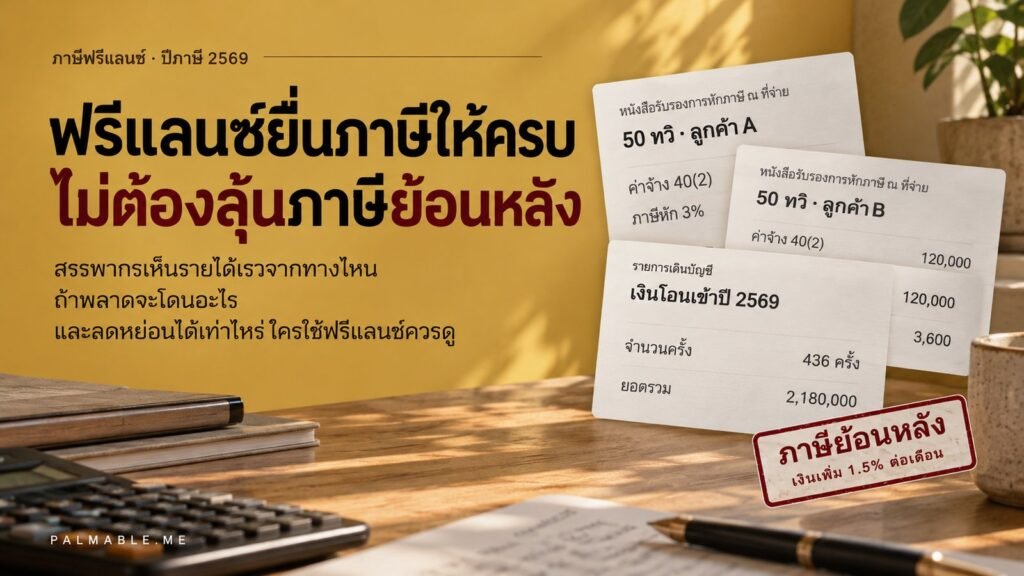
Freelancers: File Your Full Income and Stop Worrying About Back Taxes (Tax Year 2026)

Freelancer friends keep asking me some version of: "If clients just transfer money into my account, will the Revenue Department even know?" The short answer is yes — and usually before you've even filed.
In this article I cover 3 things freelancers in Thailand should know: how the Revenue Department sees your income, what happens if you under-report and get assessed for back taxes, and which deductions freelancers should use before year-end — because we don't have an employer withholding tax and providing benefits the way salaried staff do.
How does the Revenue Department know what freelancers earn?

1. Clients who withhold tax
If your client is a company, it usually withholds 3% when it pays you and gives you a withholding tax certificate ("50 Tawi"). But that certificate isn't only with you — the company also files the withheld tax with your name and ID number to the Revenue Department. So the department sees what you were paid by every company that withheld tax.
Many people think that once 3% has been withheld, their tax is done. In fact, 3% is only an advance payment. When you file early the next year, all your income is recalculated. If your real tax is higher than what was withheld, you pay the difference; if it's lower, you get a refund.
2. Banks
Under the law people call the "e-Payment tax", banks must send the Revenue Department data on accounts with frequent deposits every year. The thresholds are deposits or incoming transfers of 3,000 or more per year regardless of the amount, or 400 or more with a total over 2 million baht, counting all your accounts at the same bank together.
This isn't a new tax and doesn't mean you pay more. If you already report all your income, there's nothing to worry about. But if the money in your accounts is far higher than the income you declared, it can trigger an audit.
3. Other data used for comparison
Income you declared in previous years, contracts, invoices, or platforms that pay you can all be compared. If the income you declare suddenly drops in a given year, that year is more likely to be questioned.
What do you pay if you're assessed for back taxes?
"Back taxes" means the Revenue Department audits you and finds you under-reported or didn't file, so you must pay the missing tax plus penalties and surcharges — which together are often several times the original tax.
| What you pay | How it's calculated |
|---|---|
| Unpaid tax | The tax you should have paid, minus tax already paid |
| Surcharge | 1.5% per month of the unpaid tax from the filing deadline, capped at the amount of unpaid tax |
| Penalty | 1–2 times the unpaid tax; can be reduced if there was no intent to evade and you cooperate |
| Fine for not filing | Up to 2,000 baht |
As for how far back they can go: normally 2 years from the filing date, extended to 5 years if there's reason to believe tax was evaded — and if you never filed at all, the statute of limitations for collecting the tax runs to 10 years.
For example: A freelancer forgets to include 300,000 baht from one client and is in the 15% bracket. The unpaid tax is 45,000 baht.
If audited 3 years after the filing deadline, the surcharge is 1.5% × 36 months = 24,300 baht, plus a 1× penalty of 45,000 baht — a total of about 114,300 baht on an original tax bill of 45,000 baht.
Do freelancers have to file, and on which form?
Yes. If your total income for the year is over 60,000 baht (single) or 120,000 baht (married) and you have income other than a salary, you must file — even if your calculation shows no tax due. Filing every year is the best proof that you declared all your income.
| Income type | Example work | Expense deduction | Form |
|---|---|---|---|
| 40(2) | Contracted services, e.g. graphic design, content writing, photography, consulting | 50%, capped at 100,000 baht combined with any salary | PND 90, early the following year |
| 40(6) | Licensed professions, e.g. doctors, lawyers, engineers, architects, accountants | Actual expenses, or a flat 30–60% depending on the profession | PND 94 mid-year + PND 90 |
| 40(8) | Online sellers, influencers, contractors supplying materials | Actual expenses, or a flat 40–60% depending on the business | PND 94 mid-year + PND 90 |
The same job can be 40(2) or 40(8) depending on how the work is contracted. Check the income type your client states on the 50 Tawi certificate; if unsure, call the Revenue Department on 1161.
5 ways to avoid being hit with back taxes
- Keep a separate account for client payments. Everything paid into that account is income, and money friends send back for dinner won't get mixed in. It's easy to explain if you're ever asked.
- Keep every 50 Tawi certificate. If a client doesn't give you one, ask when you're paid. Where you don't have one, use bank statements or slips showing the payer's name.
- File every year, and report income from every client, including clients who pay in cash or don't withhold tax.
- Set tax money aside as soon as you're paid, for example 10–20% of every job depending on your bracket, so you're not scrambling for a lump sum at filing time.
- If you under-filed before, file an additional return yourself before you're called in. A voluntary additional return still carries the 1.5% monthly surcharge, but penalties are generally far lower than if an officer finds it first.
Deductions freelancers should know for tax year 2026
Salaried employees have an employer paying into social security, group insurance and a provident fund — which help with both protection and tax. Freelancers have none of this and must arrange it themselves. The good news is that many of these can be deducted from tax.
| Item | Deduction | What it gives a freelancer |
|---|---|---|
| Personal allowance | 60,000 | Everyone gets it automatically |
| Social security, Section 39 / 40 | Actual contributions | Basic cover you used to get through an employer |
| Your own health insurance premiums | Up to 25,000 | Replaces missing group insurance; combined with life insurance up to 100,000 |
| Life insurance premiums (10+ year policy) | Up to 100,000 | A lump sum for your family if something happens to you, plus savings |
| Parents' health insurance premiums | Up to 15,000 | Parents' income not over 30,000 baht a year |
| Pension (annuity) insurance premiums | 15% of income, up to 200,000 | Retirement money without a provident fund to help |
| RMF | 30% of income, up to 500,000 | Retirement savings via funds; hold until age 55 and at least 5 years |
| Thai ESG / Thai ESGX | 30% of income, up to 300,000 | Invests in Thai stocks; hold for 5 full years |
Pension insurance, RMF, provident funds and other retirement funds are capped at 500,000 baht combined. Buy or pay premiums by 31 December 2026 to use them this tax year.
Example: a freelancer earning 800,000 baht

Say a designer earns 800,000 baht in the year, all 40(2) income, with 3% already withheld by clients — 24,000 baht in total.
Without planning: expenses deduct a maximum of 100,000 baht and the personal allowance 60,000 baht, leaving net income of 640,000 baht. Tax for the year is 48,500 baht; after what was withheld, you still pay 24,500 baht
With planning before year-end: with health insurance of 25,000 baht, life insurance of 75,000 baht and pension insurance of 100,000 baht, net income falls to 440,000 baht and tax for the year is 21,500 baht. Instead of paying more, you get a refund of 2,500 baht — 27,000 baht less tax.
Don't buy insurance just to cut your tax. The 200,000 baht in premiums in this example is real money paid out. Pension and savings-type life insurance pay money back in the future, while health insurance is the cost of cover you don't get back.
The order I recommend for freelancers: health insurance first, because there's no company benefit to fall back on when you're sick; then life insurance if anyone depends on you; then retirement money. Choose amounts you can keep paying every year, because these contracts run for a long time.
To see your own numbers, enter your income and deductions in the free Thai tax & deductions calculator 2026 — it takes a few minutes and shows whether you'll pay more or get money back, and which deductions you still have left.
Frequently asked questions
3% has already been withheld — do I still need to file?
Yes. The 3% is an advance payment; when you file you may pay more or get money back. Many people on modest incomes actually get a refund.
Fewer than 400 deposits a year — does that mean I don't need to file?
No. The 3,000 deposits, or 400 deposits over 2 million, are thresholds for banks to report data. Your duty to file is based on your total income for the year as usual.
A client didn't give me a 50 Tawi certificate. What do I do?
You can still file. Use bank statements or transfer slips showing the payer's name as proof of income, and declare that income in full.
Can every health insurance policy be deducted?
The policy must meet Revenue Department conditions, and the insurer must send your deduction data to the department. Ask the insurer or agent clearly before buying, and register your intent to claim the deduction.
If you'd like help working out which cover you really need for your work and income, and how much you can deduct, message Palm on LINE — sending your tax calculator results along helps us get started faster.
Palm is an AIA life insurance agent, not an accountant or tax adviser. This article is general information based on Thai tax rules for tax year 2026 (B.E. 2569) at the time of writing. For your specific case, check with the Revenue Department (call 1161) or a tax professional. Figures in the examples are illustrative calculations.