Planning Your Child's Education Fund: How Much You Need and How to Get There

I recently got to chat with a senior friend who's a doctor. Her child is just a year and a half old, and she told me she's sending her little one to Montessori plus Shichida, Little Gym, gymnastics and swimming — and there's a nanny on top. "The nanny costs about as much as the school fees," she said. And her child hasn't even started kindergarten yet.
Most parents know school is expensive, but few have ever added up the real numbers from start to finish. In this article I'll walk through what each education path costs, the expenses parents often forget, how to save in time, and the most important backup plan: if a parent isn't around along the way, the child can still finish school.
All figures in this article are estimates and examples only. They're calculated from published school fees plus assumptions about inflation and returns. Each family's real costs will differ by school, year of entry and lifestyle. Use these numbers to see the picture and compare proportions, then enter your own family's numbers in the tool.
The education path drives the numbers more than anything
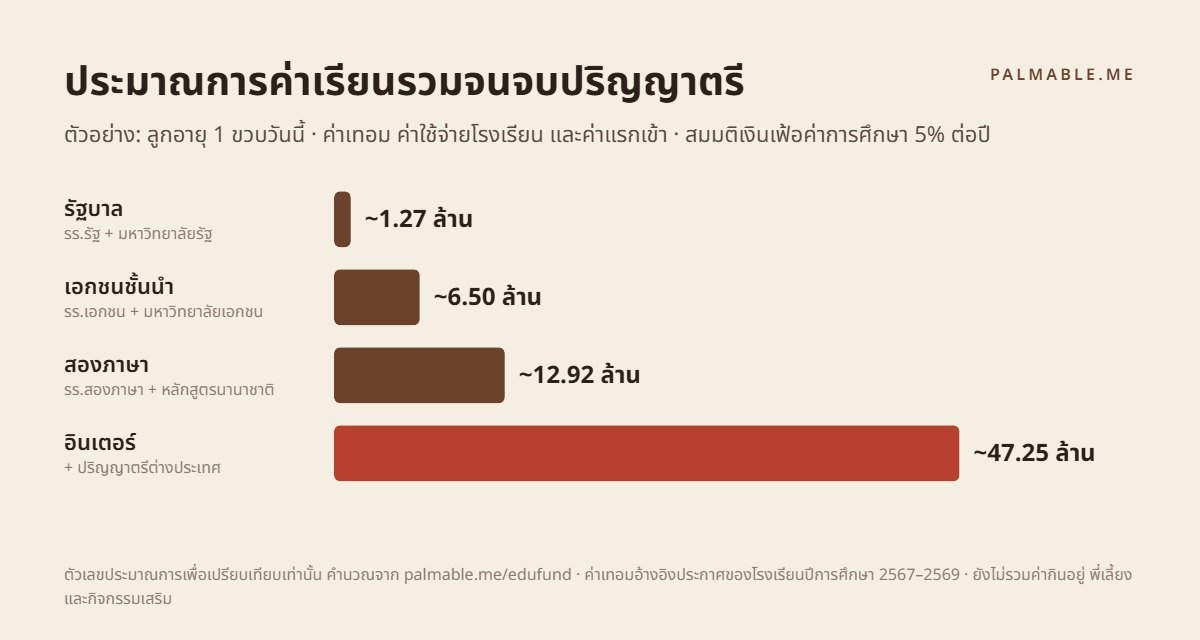
I ran an estimate with this site's child education fund planner , assuming a child aged 1 today who studies through a bachelor's degree, using published school fees and assuming fees rise 5% a year. Here are the estimates:
| Path | Example schools in the tool | Estimated total cost |
|---|---|---|
| Public | Public schools, then a Thai-programme public university | ~1.27 million |
| Top private | Mater Dei, Bangkok Christian College, Assumption College, then a private university | ~6.50 million |
| Bilingual | SBS (Satit Rangsit), then an international programme in Thailand | ~12.92 million |
| International + bachelor's abroad | Bangkok Patana, then university overseas | ~47.25 million |
Totals include tuition, other fees paid to the school (uniforms, books, school bus, etc.) and entrance fees, but not living costs, nannies or extra activities. These are estimates based on assumptions, not prices confirmed by the schools. Fees vary a lot by school and by year — try the schools you're interested in yourself in the tool.
The gap is almost 40x. So the first question before saving isn't "how much should I save each month?" but "which path do I want for my child?" Every other number follows from that answer.
4 costs parents often leave out of the plan
1. Entrance fees
Besides tuition, many schools charge a one-off entrance fee or donation, from tens of thousands to hundreds of thousands of baht. Most leading international schools are around 200,000–260,000 baht, and for some of the most sought-after schools you hear of figures in the millions. You pay it each time you change school; staying at the same school means paying once.
2. Nanny costs
Example: a nanny at 15,000 baht a month until your child is 6, assuming pay rises 3% a year, comes to about 960,000 baht in total. Families who keep a nanny through secondary school will pay several times more.
3. Extra activities
Example: Shichida at 6,000 baht a month and Little Gym at 5,000 baht until age 6, plus swimming at 3,000 baht until 12, add up to about 1.16 million baht (monthly fees here are assumptions; prices vary by provider). You pay these month by month so you barely notice, but together they come close to the cost of the entire public-school path.
4. Fees that rise every year
Thai banks estimate that tuition rises about 3–5% a year on average. At 5%, fees double in about 14 years. For example, a bachelor's programme that costs 100,000 baht a year today could cost about 230,000 baht a year by the time today's 1-year-old reaches university, if fees keep rising 5% a year.
How to save in time
School costs aren't paid as one lump sum at the end — they're paid every year for 20 years. I suggest splitting your money by when you'll need it.
| When you need the money | For example: | Where to keep it |
|---|---|---|
| Within 1–3 years | This year's fees, kindergarten entrance fee | Deposits, money market funds — no risk of loss |
| 3–10 years ahead, | Primary school fees, secondary entrance fee | A mix of bonds and some equities, or an endowment policy that matures in the year you need it |
| 10+ years | University costs | More equities early on, then reduce risk as the year you need it approaches |
Estimated example: on the top private path, 4 years of university cost about 1.58 million baht in total. Starting to save when your child is 1 gives you 17 years, and you'd need to save
about 6,500 baht a month at a 2% annual return · 5,400 baht at 4% · 4,500 baht at 6%
Returns are assumptions for the calculation, not guaranteed returns. Investing involves risk.
If you wait until your child is 10, you have 8 years left and need to save about 14,000 baht a month (at 4%) — around 2.6 times as much as starting at age 1. Starting early helps the most.
The plan parents rarely think about: what if we're not here?
Every savings plan above has one hidden condition: the parents keep earning until the child finishes school. If the parent who earns most of the family income dies or becomes disabled, the plan stops right there.

This chart is an estimated example of how much money your child still needs to finish school, counted from each year (top private path, including living costs of 10,000 baht a month). At age 1 it's as high as 9.94 million baht, then falls every year as your child grows. Subtract what you've already saved and you get a rough idea of the life cover parents should have that year. The right amount depends on each family's income, commitments and savings.
Because the need is highest when your child is small and then keeps falling, parents can choose from several kinds of life insurance for their child, depending on their goals.
| Type | Suits | What to know |
|---|---|---|
| Dedicated to your child | Parents who want a guaranteed lump sum in the year their child starts university | Endowment insurance: you get money back plus cover, but premiums are high relative to the sum insured |
| Low premium, high cover | Parents who want high cover while their child is still studying, at a low premium | Cover for a set period, with no money back at the end — but it's the most cost-effective way to protect the years when your child needs the most money |
| Balanced | Parents who want high cover with mid-range premiums | Once your child has graduated, the policy's lump sum comes back to the parents to use |
Life insurance with a term of 10 years or more can be deducted from tax, up to 100,000 baht a year (see the details on deductions in our freelance tax 2026 article). No single type is best for every family; it depends on what you can pay every year and what you want this lump sum to do after your child graduates.
Start with these 4 steps
- Choose the education path you have in mind. You don't need exact school names — just pick a level: public, private, bilingual or international.
- Add the costs people forget: entrance fees, nanny, extra activities and your child's living costs.
- Subtract what you've already saved to see how much is still missing.
- Check your existing life cover against what your child still needs. If it isn't enough, the difference is the extra cover to consider.
You can do all 4 steps in the child education fund planner — it's free, lets you pick real schools from preschool to a master's degree, and saves your results as a PDF to discuss at home.
Frequently asked questions
When should we start saving for school?
As early as you can. The earlier you start, the less you need each month, and the more time you have to invest in things that can beat bank deposits. In our example of 1.58 million baht for a private university, starting at age 1 means saving about 5,400 baht a month, while starting at 10 means about 14,000 baht.
Whose name should education insurance be in?
If the goal is to protect against something happening to a parent, the insured person should be the parent who earns the main income, with the child as beneficiary — because the money pays out when the earner is no longer there.
What education inflation rate should I use?
Thai banks estimate about 3–5% a year. If you're planning on international school or studying abroad, use the higher end, because those fees rise faster.
If you'd like help reading your results from the tool, or choosing insurance that fits your family's plan, message Palm on LINE — sending the PDF from the tool helps us get started faster.
Palm is an AIA life insurance agent. This article is general information. School fees are based on schools' published fees for academic years 2024–2026. All figures in this article are estimates and example calculations based on assumptions (5% education inflation, 3% living-cost inflation, and the stated returns), not actual costs or guaranteed returns. Coverage and conditions depend on each policy.